prototype
PharmaIntel AI
Public evidence intelligence for pharmaceutical research.
Research prototype · 2026
Overview
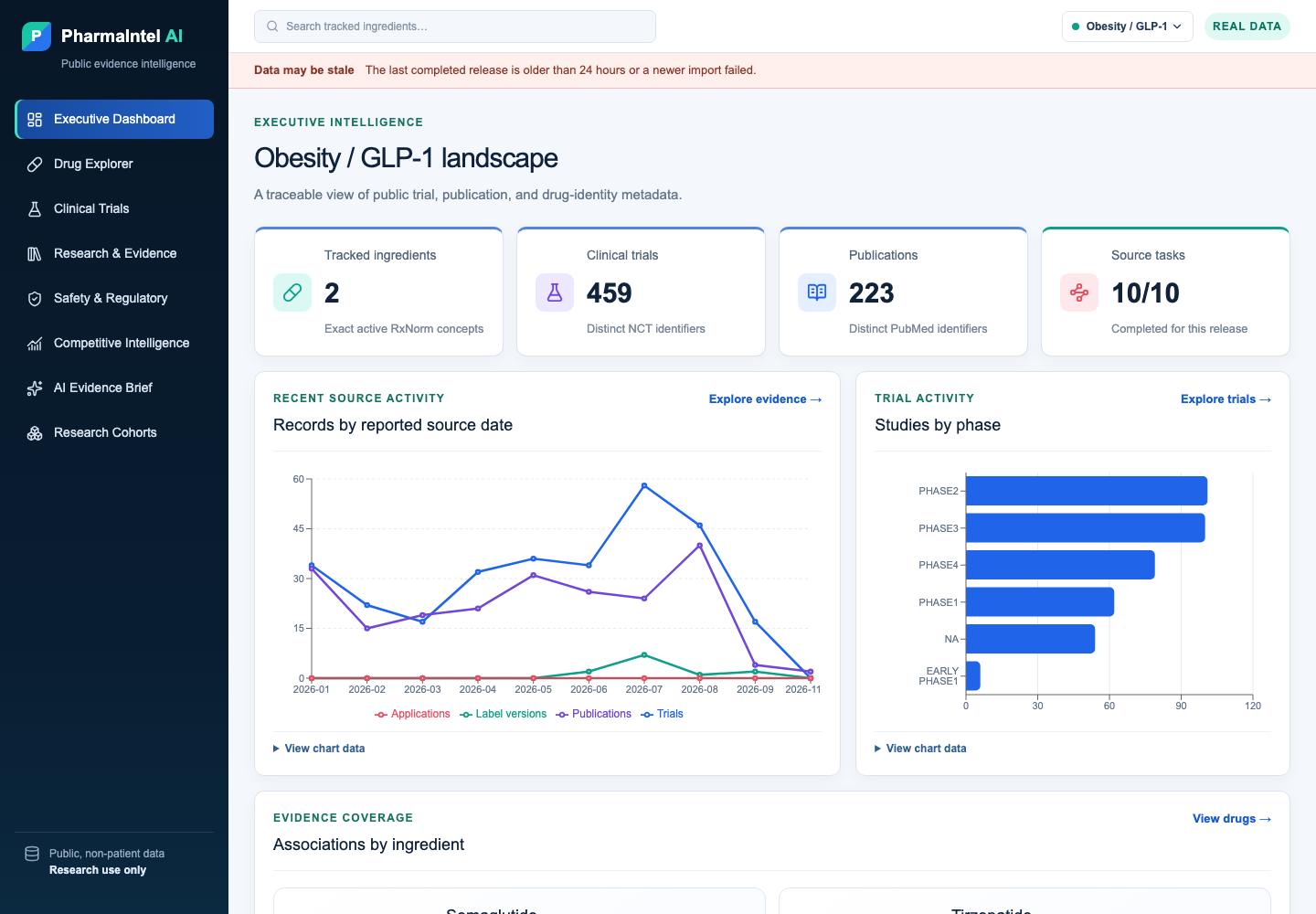
PharmaIntel AI explores how pharmaceutical researchers and strategy teams can investigate a therapeutic landscape without losing the provenance of the underlying evidence. The prototype resolves ingredients through RxNorm, imports bounded datasets from public clinical, literature, labeling, and regulatory sources, and presents the resulting evidence through cohort dashboards and focused analysis views. Immutable completed releases, source links, tables, and explicit freshness states make the evidence traceable. An optional AI evidence brief is designed to summarize only retrieved records with citations; it is not required for the core analytics workflow and has not completed a live model evaluation.
Research prototype using public, non-patient data. Not for clinical decision-making.
Problem
Public pharmaceutical evidence is distributed across sources with different identifiers, schemas, update patterns, and levels of detail. Cross-source investigation requires identity resolution, normalization, freshness tracking, and careful qualification of what each source can establish.
Concept and approach
The prototype organizes research around configurable therapeutic cohorts, exact RxNorm ingredient identities, bounded public-source imports, and immutable completed dataset releases. Charts, tables, filters, and source links keep analytical summaries connected to their underlying records.
Architecture
A TypeScript modular monolith serves the research experience, with a separate ingestion worker and PostgreSQL-backed normalized records organized into immutable completed releases.
What the prototype demonstrates
- Configure therapeutic cohorts with exact RxNorm ingredient identities.
- Import and normalize bounded public-source records with provenance.
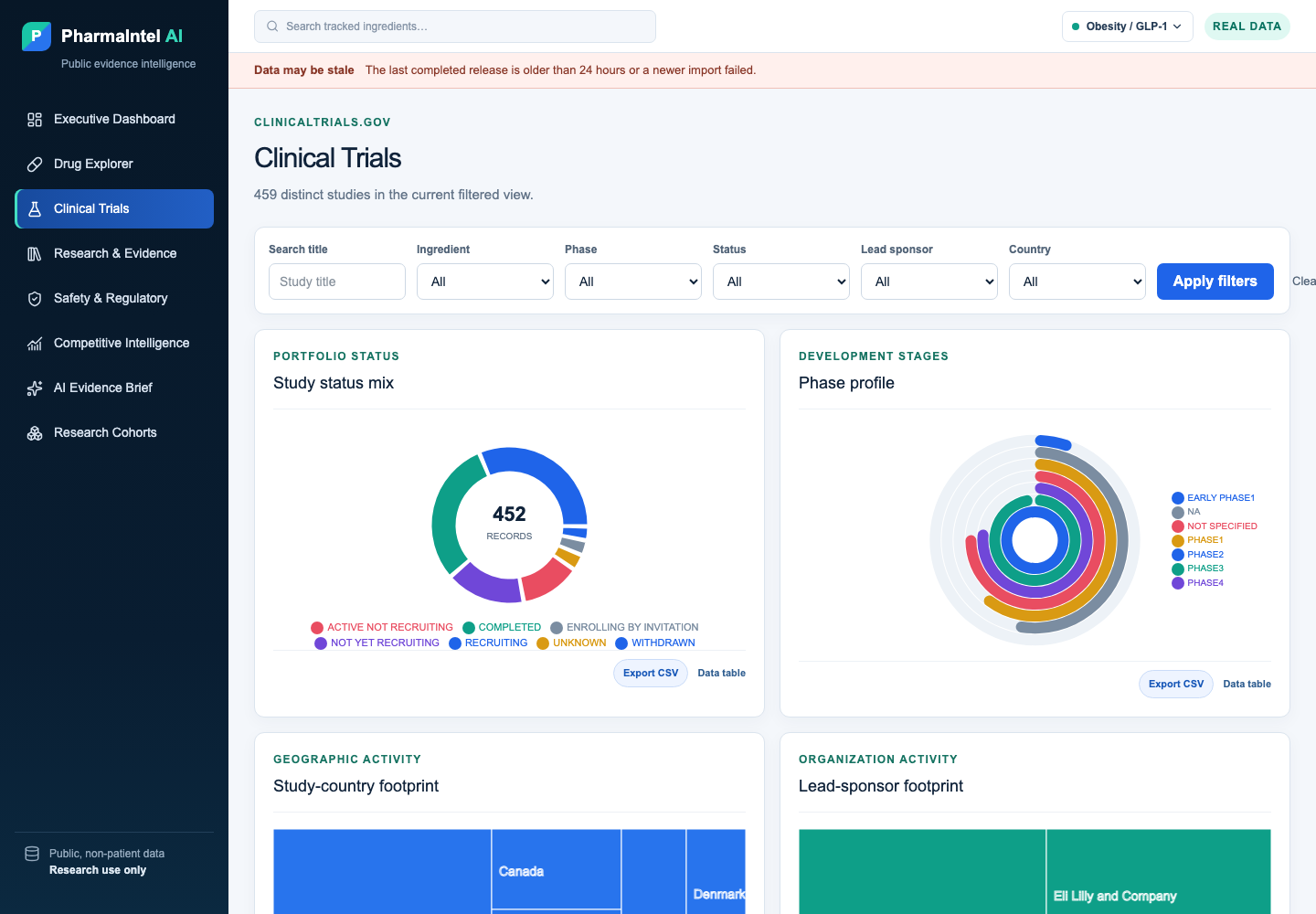
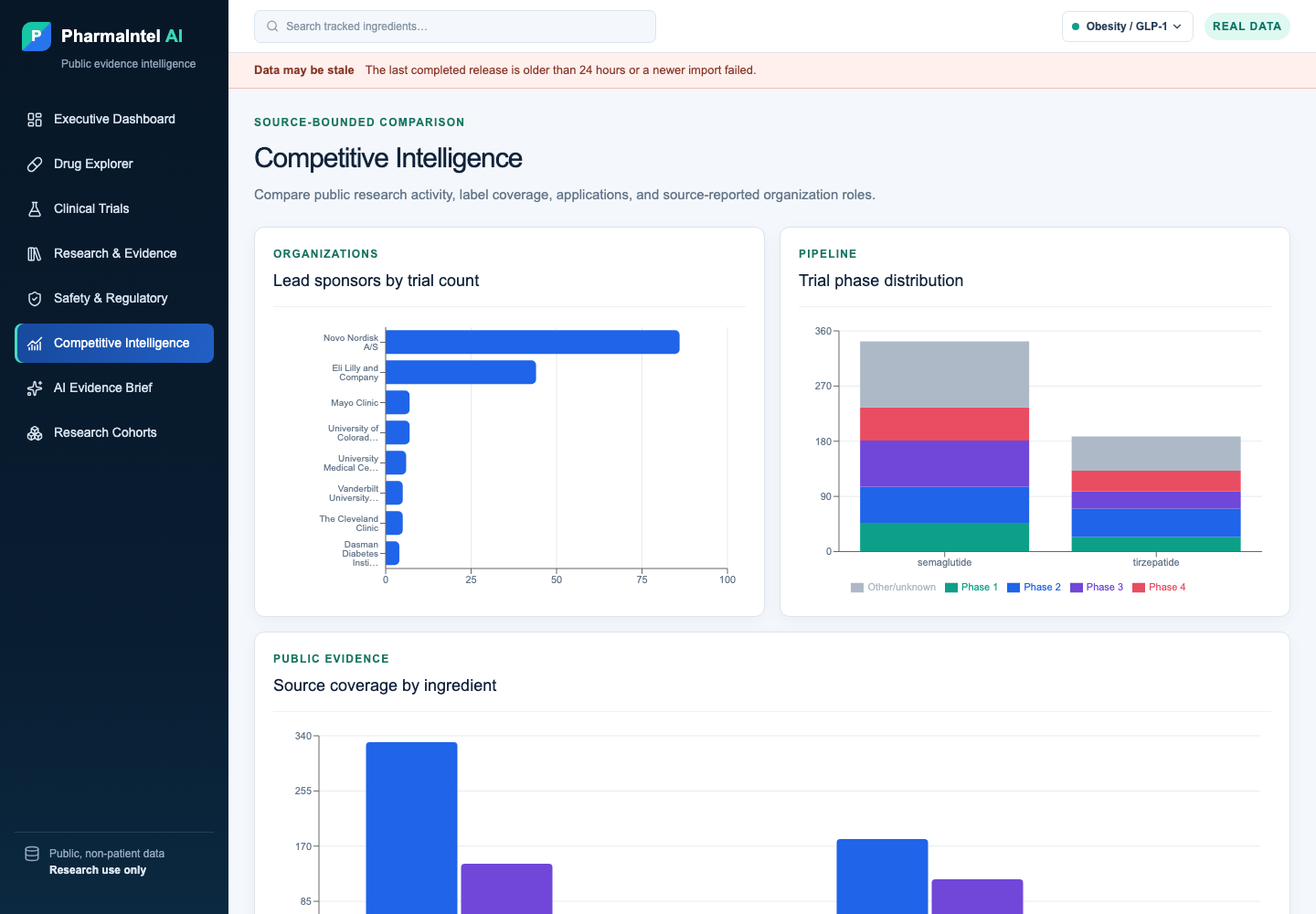
- Explore clinical trials, literature, safety and regulatory records, and competitive-intelligence views.
- Compare ingredient evidence coverage through filters, charts, accessible tables, and supported CSV exports.
- Generate an optional evidence-grounded brief when a configured model provider is available; live model quality is not yet approved.
System components
- — Next.js web application
- — Bounded ingestion worker
- — PostgreSQL and Prisma data layer
- — Public evidence-source adapters
Technology
- Next.js
- React
- TypeScript
- Tailwind CSS
- PostgreSQL
- Prisma
- Recharts
- Zod
Outcomes
- — Demonstrated a repeatable multi-source import and normalization workflow for a configured therapeutic cohort.
- — Demonstrated consistent navigation through a fixed dataset release with explicit provenance and freshness cues.
- — Demonstrated source-bounded visual comparison with accessible tables and drill-down links.
What was learned
- — Drug-identity resolution and provenance are product foundations, not post-processing tasks.
- — Immutable completed releases make analytical views reproducible while imports change.
- — Source limits, stale states, and partial failures must stay visible so charts do not imply unsupported completeness.
- — AI is safest as an optional, citation-bound layer; the evidence workflow must remain useful without it.
Prototype screens
A similar opportunity?